
Construction guarantees in South Africa: a practical guide for contractors & brokers
A project owner pays an advance, yet the contractor fails to perform, leaving no recourse. A contractor finishes a project and then watches earned revenue sit withheld for months beyond completion. A supply chain failure works its way up, and the project falls apart.
Construction guarantees exist to prevent exactly this.
They are formal instruments, backed by financial institutions, that ensure every financial obligation on a construction project is secured, from tender to final completion.
This guide covers the six core guarantees used in the South African market. We explain what each one does, when it’s required and what it means in practice for contractors and brokers.
What are construction guarantees?
Table of Contents
Construction guarantees are legally binding commitments issued by a financial institution on behalf of a contractor. They assure the project owner that, should the contractor fail to meet their contractual obligations, the guarantor will step in to cover the financial consequences up to the guaranteed amount.
Construction guarantees involve three key parties: the contractor, the project owner and the guarantor. This structure ensures that risk is distributed rather than concentrated on any single party, and that financial protection is backed by institutions with the capital to honour their commitments.
In South Africa, construction guarantees are routinely required under standard-form contracts such as the JBCC (Joint Building Contracts Committee) and NEC, and for public-sector procurement governed by the CIDB (Construction Industry Development Board).
South Africa’s construction guarantees at a glance
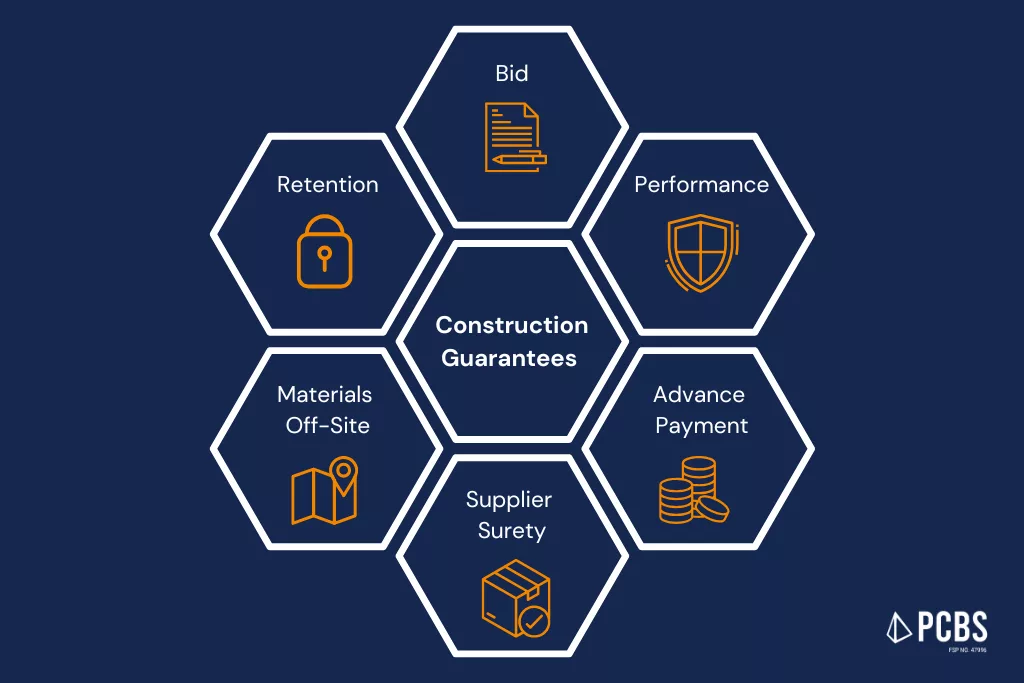
The table below summarises each guarantee’s purpose and typical value. Full details, including what it means for contractors and brokers, follow in the next section.
| Guarantee | Project owner benefits | Contractor benefits | Key detail | Main risks covered |
|---|---|---|---|---|
| Bid Bond | Filters out speculative tenders and recovers re-tendering costs if the winning bidder withdraws. | Signals credibility and financial standing at tender stage. |
Required: At tender submission Typical value: 1–2% of tender value |
Contractor withdraws after winning the bid. |
| Performance Guarantee | Protection against incomplete or substandard work throughout the contract. | Independent validation of the contractor's capability and capacity. |
Required: On contract award Typical value: 5–10% of contract value |
Failure to complete the project or poor performance. |
| Retention Guarantee | Maintains recourse against defects during the defects liability period. | Releases retained cash, improving project and business cash flow. |
Required: At practical completion Typical value: Replaces the retained cash amount |
Defects identified during the liability period. |
| Advance Payment Guarantee | Allows recovery of advance payments if the contractor defaults. | Unlocks upfront capital to begin work efficiently. |
Required: When an advance payment is made Typical value: Equal to the advance amount |
Contractor fails after receiving the advance payment. |
| Materials Off-Site Guarantee | Protects materials that have been paid for but have not yet arrived on site. | Improves cash flow through early payment for procured materials. |
Required: When off-site materials are certified Typical value: Value of certified materials |
Materials are lost, pledged or never delivered. |
| Supplier Surety | Reduces supply-chain risk affecting the main construction contract. | Ensures suppliers are paid without reducing contractor working capital. |
Required: At subcontract award Typical value: Varies by project |
Supply chain disruptions caused by procurement funding gaps. |
The six main construction guarantees – and what they mean for you
1. Bid Bond: Putting serious intent behind your tender
When contractors submit tenders, project owners need assurance that the bidder is serious, financially capable and willing to proceed if awarded the contract. That is the purpose of a Bid Bond.
A Bid Bond guarantees that the contractor will enter into the contract if their tender is accepted, and that they will provide the required Performance Guarantee upon award.
If the winning bidder withdraws or fails to meet contract award conditions, the project owner is compensated – typically for the cost difference between the defaulting bid and the next acceptable offer, or the cost of re-tendering.
Bid Bonds are especially important in public-sector tendering, where speculative bids waste public resources and delay delivery.
What contractors should know
A Bid Bond is likely a non-negotiable requirement before your tender is even opened on public-sector or larger private projects. For emerging contractors, this is often the first point of contact with the guarantee market – and the quality of your guarantor matters. A Bid Bond from a reputable financial services provider signals to the project owner that you have been assessed and found credible. Factor the cost into your tender-preparation budget and allow sufficient lead time.
What brokers should know
The Bid Bond is your earliest opportunity to add value in a contractor’s project lifecycle. Contractors approaching you at tender stage are often under time pressure – your speed and established underwriter relationships matter. Ensure the guarantee wording meets the project owner’s specific requirements. Mismatched wording is one of the most common reasons Bid Bonds are rejected at tender submission.
2. Performance Guarantee: The guarantee every project needs

The Performance Guarantee is the cornerstone of construction guarantees in South Africa – the most widely required and the most significant in terms of financial exposure.
It protects the project owner against the risk of a contractor failing to complete the project as contracted, whether due to financial failure, poor workmanship, delays or abandonment. Should the contractor default, the guarantor must compensate the project owner up to the guaranteed sum.
Its dual role (backstop and prequalification mechanism) makes the Performance Guarantee the most valuable risk-management tool available on construction projects in South Africa
Performance Guarantees are typically set at between 5% and 10% of contract value in South Africa, though some contracts require higher cover. A key feature of these instruments is that they remain in force for the full duration of the contract, providing consistent protection throughout.
Beyond financial protection, Performance Guarantees serve a second function: the guarantor’s willingness to issue a bond is itself a quality signal. When an underwriter backs a contractor, it means an institution with direct financial exposure to the outcome has assessed that contractor and found them capable of delivery.
This dual role (backstop and prequalification mechanism) makes the Performance Guarantee the most valuable risk-management tool available on construction projects in South Africa.
What contractors should know
Your performance Guarantee is a direct reflection of your financial standing. Underwriters assess your capital adequacy, company structure, contract track record and the specific project risks before issuing. For emerging contractors, guarantee facilities often gate growth: you can’t take on larger contracts without adequate bonding capacity. For established contractors, the priority shifts to facility management: ensuring your aggregate guarantee exposure does not crowd out your bonding capacity.
What brokers should know
The critical distinction to understand (and explain to clients) is whether the contract calls for an on-demand or conditional guarantee. On-demand guarantees can be called without the project owner proving default, which is a different risk profile and attracts different underwriting terms. Brokers who understand this distinction and can negotiate appropriate wording on behalf of contractors deliver genuine value.
3. Retention Guarantee: Turning withheld cash into working capital
Traditionally, employers withheld a portion of contract payments (typically 5%) as a security fund to cover defects or incomplete work after project completion. While this protected the project owner, it placed significant strain on contractor cash flow, tying up funds that could otherwise be reinvested in the project or the business.
The Retention Guarantee replaces this withheld cash with a formal guarantee instrument, freeing up contractor cash flow while still protecting the project owner’s interests. Rather than holding back funds, the project owner holds a guarantee that can be called upon if defects arise during the defects liability period.
Research published in the International Journal of Architecture, Engineering and Construction found that retention bonds reduce the level of risks and problems associated with construction project performance, with direct implications for project cost and time. The mechanism is straightforward: contractors who are not cash-starved perform better.
Retention Guarantees are an underutilised product in South Africa relative to their potential value to contractors
What contractors should know
On a R10 million contract with 5% retention, R500,000 of your earned revenue is withheld – sometimes for months beyond practical completion. Across a portfolio of projects, this adds up fast. A Retention Guarantee converts the locked cash into a liquid asset. If the project owner is open to accepting a guarantee instead of cash retention, raise it at contract-negotiation stage. Once the contract is signed, the conversation becomes significantly harder.
What brokers should know
Retention Guarantees are an underutilised product in South Africa relative to their potential value to contractors. Many contractors are unaware they can negotiate a guarantee in place of cash retention, or do not know how to raise it contractually. Educating clients on this option – and being ready to place the instrument quickly when agreed – is a genuine differentiator. The instrument is relatively straightforward to underwrite, making it a good entry point for newer broker-client relationships.
4. Advance Payment Guarantee: Securing upfront capital risk-free
Many construction contracts allow the project owner to make an advance payment to the contractor before work begins. This upfront funding enables the contractor to mobilise plant and equipment, procure materials and establish site infrastructure. It also creates significant financial exposure for the project owner.
The Advance Payment Guarantee protects against that risk. It guarantees that the project owner can recover the advance if the contractor fails to perform. The guaranteed amount typically decreases proportionally as work is certified, reflecting the reducing financial exposure as the project progresses.
A 2024 study published in the World Journal of Advanced Science and Technology, describes advance payment guarantees as a critical financial instrument designed to mitigate risks associated with pre-financing and ensure project stability – particularly on larger infrastructure contracts where mobilisation costs are substantial.
What contractors should know
An advance payment can be a real project enabler, particularly for emerging contractors who need upfront capital to mobilise effectively. However, securing an Advance Payment Guarantee requires demonstrating to the underwriter that you have the financial capacity and project capability to justify the advance. Your financial statements, bank references and project track record need to be in order before you request an advance payment provision.
What brokers should know
Pay particular attention to the reduction mechanism: how the guaranteed amount decreases as the advance is recovered. Poorly drafted reduction clauses are a common source of disputes. Regular communication between the project owner, contractor and guarantor is essential to prevent misunderstandings, and the broker is well placed to facilitate this coordination throughout the project lifecycle
5. Materials Off-Site Guarantee: Covering materials before they arrive

On large or specialist projects, significant quantities of materials and equipment are often procured and stored off-site before they are incorporated into the works. Without protection, the project owner faces the risk of paying for materials held elsewhere that could be sold, pledged as security or lost if the contractor encounters financial difficulty.
The Materials Off-Site Guarantee assures the project owner that materials procured for the project and held off-site are secured, accounted for and will be delivered to the site as required. At the same time, it enables contractors to be paid for stored materials, improving cash flow at a stage when expenditure is high and certified work is still limited.
What contractors should know
If your project involves significant off-site procurement, raise a Materials Off-Site Guarantee at the contract-structuring stage, not after materials have already been procured. The earlier the conversation, the easier the coordination.
What brokers should know
These guarantees require coordination between the guarantee wording, the contract’s off-site materials provisions and any storage and insurance arrangements. The underwriter will want assurance that materials are properly identified, insured and held exclusively for the project. Your role is to facilitate this coordination.
6. Supplier Surety: Funding & securing the supply chain

Payment failures moving through the supply chain are among the most common causes of project delays and contractor insolvencies in South Africa. If a contractor can’t fund procurement, the supply chain stalls, and the project is at increasing risk of breaking down.
Supplier Surety addresses the problem at the source. Rather than requiring contractors to tie up their working capital to obtain the goods, materials, equipment and services needed for the project, a supply chain credit facility funds procurement directly.
The contractor gets what they need to keep the project progressing. The supplier gets paid on time. And the project owner is assured that the supply chain is funded and formally secured.
By introducing the guarantor as a backstop in the supply chain relationship, Supplier Surety reduces the risk of failure reaching the main contract.
What contractors should know
A Supplier Surety credit line gives you access to procurement funding without drawing on your working capital. Your suppliers get paid, your procurement stays on schedule and your cash flow is available for the operational demands of running the project. For contractors managing multiple projects, this is an advantage that compounds across a portfolio.
What brokers should know
This is a growth area in South Africa as contractors face increasing pressure to formalise supply chain risk management. Many contractors are unaware that procurement funding of this type is available through a guarantee provider rather than a bank. Brokers who understand this product and can explain it clearly are better positioned to serve larger contractors with complex procurement requirements.
Construction guarantees: the foundation of every successful project
Every construction project moves through stages of financial exposure, from the moment the tender is submitted to the final resolution of defects. The six construction guarantees covered in this guide each target a specific point in that sequence.
Together, they form a complete framework that keeps projects financially viable, holds every party accountable and ensures that when something goes wrong, there is a structured, funded mechanism to resolve it.
Frequently Asked Questions About Construction Guarantees in South Africa
Can an emerging contractor qualify for a Construction Guarantee facility?
Yes. Underwriters assess capital adequacy, company structure and project track record, not company age or size. Emerging contractors can qualify, though facility size and terms will reflect their current financial position. Working with a specialist provider like PCBS is typically more accessible than approaching a general bank, because specialist underwriters understand the construction sector’s growth cycle and can structure facilities that develop alongside your business.
What is the difference between an on-demand and a conditional guarantee?
An on-demand guarantee can be called by the project owner without proof of contractor default. A conditional guarantee requires demonstrated breach of contract before a claim is paid. On-demand guarantees carry significantly greater risk exposure for contractors and attract higher premiums. Understanding which type your contract requires, and negotiating the wording accordingly, is one of the most important decisions in the guarantee process.
How quickly can a Construction Guarantee be issued?
With complete documentation, PCBS typically quotes within 24 to 48 hours, issues a draft guarantee within 24 to 48 hours, and has the original ready within 24 hours of payment confirmation. The most common cause of delays is incomplete financial information at application stage. Preparing your documents in advance is the single most effective way to speed up the process.
Can a contractor negotiate a Retention Guarantee instead of cash retention?
Yes – and it is more achievable than most contractors realise. Retention Guarantees are increasingly accepted on well-structured South African projects, particularly where the contractor has a credible guarantor and the contract form allows for it. Raise it at contract-negotiation stage.
What documentation is needed to apply for a Construction Guarantee?
Underwriters typically require recent financial statements, a company profile, contract details including value and duration, and information on existing guarantee facilities or financial commitments. Requirements vary by guarantee type and project size. Having this documentation prepared before you approach a provider significantly improves both turnaround time and the quality of the facility you’re offered.
References
1. Oke, A.E. (2013). Benefits and Level of Using Retention Bond for Construction Projects in Nigeria. International Journal of Architecture, Engineering and Construction, 2(2), 98–105.
https://www.researchgate.net/publication/272881330_Benefits_and_Level_of_Using_Retention_Bond_for_Construction_Projects_in_Nigeria
2. Latilo, A., Uzougbo, N.S., Ugwu, M.C., & Oduro, P. (2024). Role and Effectiveness of Advance Payment Guarantees in Construction Contracts. World Journal of Advanced Science and Technology, 6(1), 88–102.
https://www.researchgate.net/publication/383492047_Role_and_effectiveness_of_advance_payment_guarantees_in_construction_contracts